Meet the Playwrights: Teresa Miller

LOGO - New York Shakespeare Exchange + The Cry Havoc Company present Brave New Work

In partnership with our friends at The CRY HAVOC Company, we are thrilled to announce that we've chosen our cohort of four playwrights for the inaugural cycle of our development series, Brave New Work. The series invites playwrights to create original works that will draw inspiration from Shakespeare's canon, but evolve into something wholly their own.


Meet the Playwrights
TERESA MILLER

Teresa Miller is a Philadelphia-based playwright and multidisciplinary theatre artist whose work bridges history, community, and imagination. She writes character-driven plays exploring memory, race, labor, and legacy, including Ephraim Slaughter: Freedom’s Witness and Last Night in Jerusalem. Her plays have been developed with theatre companies and museums, and she was selected as one of four writers for the Cry Havoc Company’s Brave New Work: Shakespeare as Prologue inaugural cohort in collaboration with the New York Shakespeare Exchange, an experience she is deeply honored and excited to be part of. Across her work, she centers storytelling as a tool for connection, dignity, and cultural preservation.

Which of Shakespeare's plays have you chosen as the springboard for your play? What intrigues or excites you about building on that foundation? 

What has always intrigued me about Hamlet is that it ends with almost everyone dead, but the emotional and political consequences of those deaths are largely left unexplored. We leave the play with Horatio as the sole surviving witness, charged with telling the story. That moment felt like an opening rather than a closing. My play After Denmark begins in that silence. I’m interested in what happens when the spectacle of tragedy has ended and only the witnesses remain. What does it mean to carry the memory of a kingdom that has collapsed? How does someone explain those events to people who were never there?

Which NYC neighborhoods make you feel the most at home? 

Although I am not a New Yorker, I’ve always felt at home in Harlem. There's something about Harlem that feels deeply theatrical. From the layering of history, music, street life, and memory. It’s a place where past and present feel like they’re standing beside each other on the same block. As a playwright who is interested in memory, lineage, and the way stories live inside communities, Harlem has always felt like a neighborhood where storytelling is embedded in the architecture The streets carry the echoes of writers, musicians, organizers, and ordinary people whose lives were anything but ordinary.

What types of prompts or source material are you most drawn to as a playwright?  How would you describe your artistic voice or point-of-view? 

I’m drawn to history, memory, and the spaces where personal lives intersect with larger historical forcesMany of my plays begin with a question about what has been forgotten or overlooked. I’m interested in the people who stand at the edges of historical narratives and those are the witnesses, the survivors, the ones tasked with carrying the story forward. Sometimes the starting point is archival research. Sometimes it’s a fragment of history that refuses to let go. Sometimes it’s a literary text that contains a silence I want to explore. I’m particularly interested in the tension between documented history and lived experience and how theater can hold both at the same time. My artistic point of view often sits at the intersection of history, memory, and the surreal. I ’m interested in plays that move between the visible world, the invisible one and between what can be documented and what can only be felt. Many of my plays include elements of magical realism or heightened theatricality because memory itself rarely moves in a straight line. I’m also deeply interested in witnessing. And that is who bears witness to events? Who gets to narrate them and what responsibility comes with that act. Whether I’m writing about a historical figure, a community, or a fictional character, my goal is to create work that invites audiences to step into a moment where past and present are in conversation with each other.


Save the Date – April 25th!

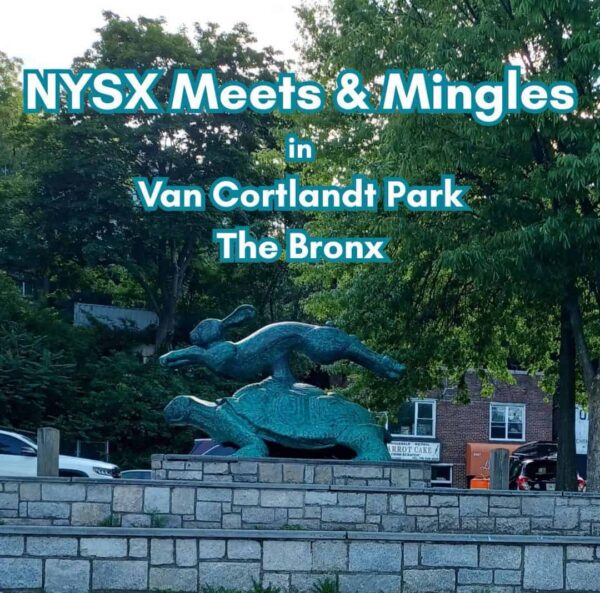
Introducing: NYSX Meets & Mingles

Our 2026 calendar will include a series of four casual gatherings, bringing together new friends and old in a space where new connections can bloom and community bonds can get stronger. Some might be creative in vibe (like an open mic or poetry reading), some might be more focused on networking and building support systems, and some will be pure silly fun!


SAVE THE DATE!

Verses vs. Verses

Saturday, April 25

Our next Meets & Mingles event will be an open-mic salon, inviting local poets and Shakespeare fans alike to come help us celebrate National Poetry Month, which also happens to be the Bard's birthday month.

Watch this space for more details coming soon, including how to register if you want to perform!


Meet the Playwrights: Mollie Gordon

LOGO - New York Shakespeare Exchange + The Cry Havoc Company present Brave New Work

In partnership with our friends at The CRY HAVOC Company, we are thrilled to announce that we've chosen our cohort of four playwrights for the inaugural cycle of our development series, Brave New Work. The series invites playwrights to create original works that will draw inspiration from Shakespeare's canon, but evolve into something wholly their own.


Meet the Playwrights
MOLLIE GORDON

Mollie Gordon (she/her) is a queer playwright and theatre-maker based in Newark, New Jersey. She is currently a member of the 2025-26 QueerSpeech Cohort with The Cult Collective. Her play If It Weren't for the Women, We'd Still Be Stuck in the Desert was a 2024 O'Neill National Playwrights Conference semifinalist, the 2024 winner of the Scribe Playwriting Competition, finalist for the 2026 MOXIE Lamoise New Works Festival, and long listed for the 2026 Distillery New Works Festival. Mollie's plays have been developed with The Bechdel Group, Athena Project, Personal Pizza Party, and Sarah Lawrence College.


Which of Shakespeare's plays have you chosen as the springboard for your play? What intrigues or excites you about building on that foundation? 

I've chosen Measure for Measure as the springboard for my play. It's a play that feels very timely with its themes of political hypocrisy and whose voice society chooses to believe. Isabella is an incredibly captivating and memorable central character, yet she only has half as many lines as the Duke. Her fate is left really ambiguous at the end of Shakespeare's play, so I was interested to imagine a more hopeful future for her. 

Which NYC neighborhoods make you feel the most at home? 

I always feel really at home in the West Village - it's a great area to just walk around and I love the restaurants. I grew up in Cobble Hill, so I also love to visit my favorite places there, particularly the Brooklyn Farmacy & Soda Fountain!

What types of prompts or source material are you most drawn to as a playwright?  How would you describe your artistic voice or point-of-view? 

I'm drawn to prompts/source material that feel unresolved or open-ended. I think this is because my artistic voice can be very playful, and I like to use devices like magical realism to explore the unexplored. This is why I find comedy an indispensable tool as well, because an audience that laughs together is more likely to want to talk to each other. I love when theater can open a conversation rather than close it, so a piece as richly complicated as Measure for Measure feels like an exciting jumping-off point.


Meet the Playwrights: Maximillian Gill

LOGO - New York Shakespeare Exchange + The Cry Havoc Company present Brave New Work

In partnership with our friends at The CRY HAVOC Company, we are thrilled to announce that we've chosen our cohort of four playwrights for the inaugural cycle of our development series, Brave New Work. The series invites playwrights to create original works that will draw inspiration from Shakespeare's canon, but evolve into something wholly their own.


Meet the Playwrights
MAXIMILLIAN GILL

Maximillian Gill’s work has been staged by a number of companies and festivals including the Liverpool Arab Arts Festival in Liverpool, Theatre West in Los Angeles, the Abingdon Theatre Company, Gloucester Stage Company in Massachusetts, and the New York City Children’s Theater. His plays include Your Undecaying Flames (Eugene O’Neill National Playwrights Conference short list finalist), Stay Up and Keep Rolling (Eugene O’Neill National Playwrights Conference semi-finalist, Premiere Stages semi-finalist), Machines Eat People (Seven Devils Playwrights Conference semi-finalist), and Blank Slate (Bay Area Playwrights Festival semi-finalist). Much of his work can be read on New Play Exchange.


Which of Shakespeare's plays have you chosen as the springboard for your play? What intrigues or excites you about building on that foundation?
I chose Macbeth as my play. It's one of my favorites because it's the one best suited for an '80s goth rock soundtrack. I also enjoy the way it pretends it's telling a story from history, but by the time Shakespeare got his hands on it, it was so far from the original events that we get witches. 

Which NYC neighborhoods make you feel the most at home?
Queens is my favorite borough maybe because it's under-rated? Take the 7 train and do a world food tour with restaurants in Sunnyside, Woodside, or Elmhurst.

What types of prompts or source material are you most drawn to as a playwright?  How would you describe your artistic voice or point-of-view?
I tend to be a cynical optimist. My characters end up hopeful because they have to, but the journey there is usually tough. I like prompts that allow latitude in terms of tone because my work tends to not fall easily into either comedy or drama but freely draws from both.