Meet our Collaborators: The CRY HAVOC Company

LOGO - New York Shakespeare Exchange + The Cry Havoc Company present Brave New Work

As we draw close to the end of this inaugural cycle of Brave New Work, we wanted to cast our final spotlight on our partners in bringing this exciting new initiative to life!


Meet our Collaborators
The CRY HAVOC Company

The CRY HAVOC Company believes that writing a script doesn’t have to be a solitary experience, and that feedback at key points in the writing process can bring you closer to your goals. Their approach to script development places the writer’s goals at the center of the workshop discussion, ensuring that collaborators are offering feedback in service of the writer’s vision – the play they are trying to write.

Read on to learn more about the company’s approach to developing new work, what excites them about this collaboration with NYSX, and more – featured company members are Jen Curfman (Co-Artistic Director), Jerzy Gwiazdowski (Managing Director), and Katelin Wilcox (Associate Artistic Director).

===

What are your favorite elements of CRY HAVOC's approach to new play development? What elements do playwrights seem to find most effective or enriching?

Jen:  In the CRY HAVOC approach, playwrights are empowered to articulate their goals for their script during the moderated discussion, which allows focused, specific feedback from the artists at the table. It’s thrilling to be in the room with a community of artists who are there in service of each other’s work. Playwrights often tell us that the collaborative space helps them challenge their own writing process and deepen their work. 

Jerzy:  I love meeting and working with writers. Selfishly, that's my favorite part. Writing can be so lonely; our development process meets a writer where they are and brings their work into a room full of artists ready to support their goals.

Katelin:  I think our guiding principle of "helping the playwright write the play they are trying to write" and the facilitator component are things that I, and our playwrights, really respond to. Sometimes feedback processes can be muddied by personal taste and opinions. We've worked really hard to create a structured approach that keeps feedback focused and, with the role of the facilitator, helps the playwright be prepared to receive and synthesize that feedback. 

What excites you most about the Brave New Work collaboration with NYSX?  

Katelin:  I love Shakespeare and I have been absolutely blown away by the way our playwrights have taken his work as a jumping-off point and come up with such varied, creative, thought-provoking work.  There are lots of little reference points that will delight Shakespeare nerds like me, but the plays also stand completely on their own.  I also feel that as artists we are in desperate need of artistic community right now, and this collaboration has allowed both companies to expand our respective communities of artists in a beautiful, exciting way.  

Jen:  As artists, we have the opportunity to interrogate the works of Shakespeare just as much as we celebrate these plays. What could be more exciting than bringing today’s writers together to challenge and dance with Shakespeare in their own voices? Brave New Work indeed!

Jerzy:  The project doesn't take Shakespeare for granted. Each writer in the cohort (and everyone that applied to the program) brought their unique experience of Shakespeare's work to the table. These plays mean so much to so many and Brave New Work demonstrates that meaning through the perspectives of these four brilliant contemporary artists.

If you could set a new adaptation of any Shakespeare play within a particular neighborhood, area, or demographic/cultural group in 2026 NYC, what would your pitch be?

Jerzy: Let's put Timon of Athens in modern Manhattan. New York has the highest concentration of extreme wealth in the United States - the country with the highest income inequality among the world's so-called "developed" nations. In New York City, the racial wealth gap is even more grotesque. The city's density forces us to confront, or at least witness, these contradictions daily. Seems like an apt setting for a play about wealth, poverty, false generosity, loyalty and the structures that sustain inequality.

Katelin: I've lived in Sunset Park, Brooklyn for over a decade, and our namesake park is such an oasis of calm and fun within the hustle and bustle of our busy neighborhood.  I'm a sucker for site-specific theater, so I think it would be fun to set one of the plays that contrast "court and country life" (As You Like It, Midsummer, Winter's Tale, Cymbeline) partly in our busy commercial district and partly in Sunset Park itself, taking the audience along for the ride!

Jen:  Whether it’s examining modern politics through Mark Antony, exploring the fluidity of gender with Viola, or grieving a lost homeland with Thomas Mowbray, there’s something in Shakespeare that speaks to our joys, our rage, our city, our moment. The possibilities are endless!


Meet the Playwrights: Marcus Scott

LOGO - New York Shakespeare Exchange + The Cry Havoc Company present Brave New Work

In partnership with our friends at The CRY HAVOC Company, we are thrilled to announce that we've chosen our cohort of four playwrights for the inaugural cycle of our development series, Brave New Work. The series invites playwrights to create original works that will draw inspiration from Shakespeare's canon, but evolve into something wholly their own.


Meet the Playwrights
MARCUS SCOTT

Marcus Scott is a dramatist and journalist. Notable plays include Tumbleweed (2025 Orlando Shakes PlayFest), Sibling Rivalries, and There Goes the Neighborhood, which have collectively earned finalist recognition from the O’Neill NPC, Princess Grace Awards, Blue Ink Award, SDNPF and BAPF. Musical credits include Cherry Bomb and a commissioned adaptation of Beethoven’s Fidelio for Heartbeat Opera (The Met Museum; NY Times Critic’s Pick). Recent honors include the Robert Chelsey/Victor Bumbalo Award, a Helene Wurlitzer Foundation Residency, and finalist status for the 2025 Ryan Hudak LGBTQ+ Award, the Dramatists Guild Foundation National Fellowship, and the Many Voices Fellowship. MFA: NYU Tisch. 

Which of Shakespeare's plays have you chosen as the springboard for your play? What intrigues or excites you about building on that foundation? 

I’ve chosen The Tempest as the springboard for my play. I’m fascinated by its perturbing resolution; the way it performs forgiveness while leaving huge ethical tensions simmering under the surface. Prospero renounces his magic, but the systems of control he built over the island, over Ariel, and over Caliban are never truly interrogated. That lingering silence is what gets me. Prospero is a paranormal propagandist — a father and a playwright orchestrating reality. I wanted to explore the aftershock of that magic. What happens when the architect of the narrative disappears? When the script is gone, whose memory prevails? This play enters the space after the “happy ending” to see if liberation is possible when the language of power still hangs in the air.

Which NYC neighborhoods make you feel the most at home? 

Harlem and Bed-Stuy are where I feel most at home. There’s an intellectual and sociological electricity in Harlem that feels ancestral and forward-thinking; you can practically feel the lineage of artists, culturati, organizers, preachers, dreamers in the pavement. It’s a continuum of Black brilliance where possibility feels infinite. Bed-Stuy was my first home during grad school, and it’s communal in a way you don't find elsewhere. It’s the rhythm of stoop conversations, music spilling from open windows, and "aunties" who will read you for filth before inviting you in for a homecooked meal. Both neighborhoods are meccas where ambition and authenticity coexist — places where Black nerds, artists, and strivers can just be without needing a translator.

What types of prompts or source material are you most drawn to as a playwright?  How would you describe your artistic voice or point-of-view? 

I’m drawn to material that interrogates power: who wields it, who enforces it, and who dares to resist it. In an era of endless reboots, I’m less interested in the repetition and more interested in the afterlife. I want to see the psychological debris left at the margins of the “canon” once the curtain falls. My work is an excavation of Black interiority. I’m fascinated by the contradictions — Silicon Valley futurists, Divine Nine social climbers, and Afropunk rockers. My voice is analytical but lyrical; 

I want to deconstruct narratives shaped by capitalism and anti-Blackness to help characters reclaim what’s been stolen, whether that’s memory or self-definition. Ultimately, I believe imagination is the most radical tool we have for reclamation.


Verses vs. Verses – April 25th!

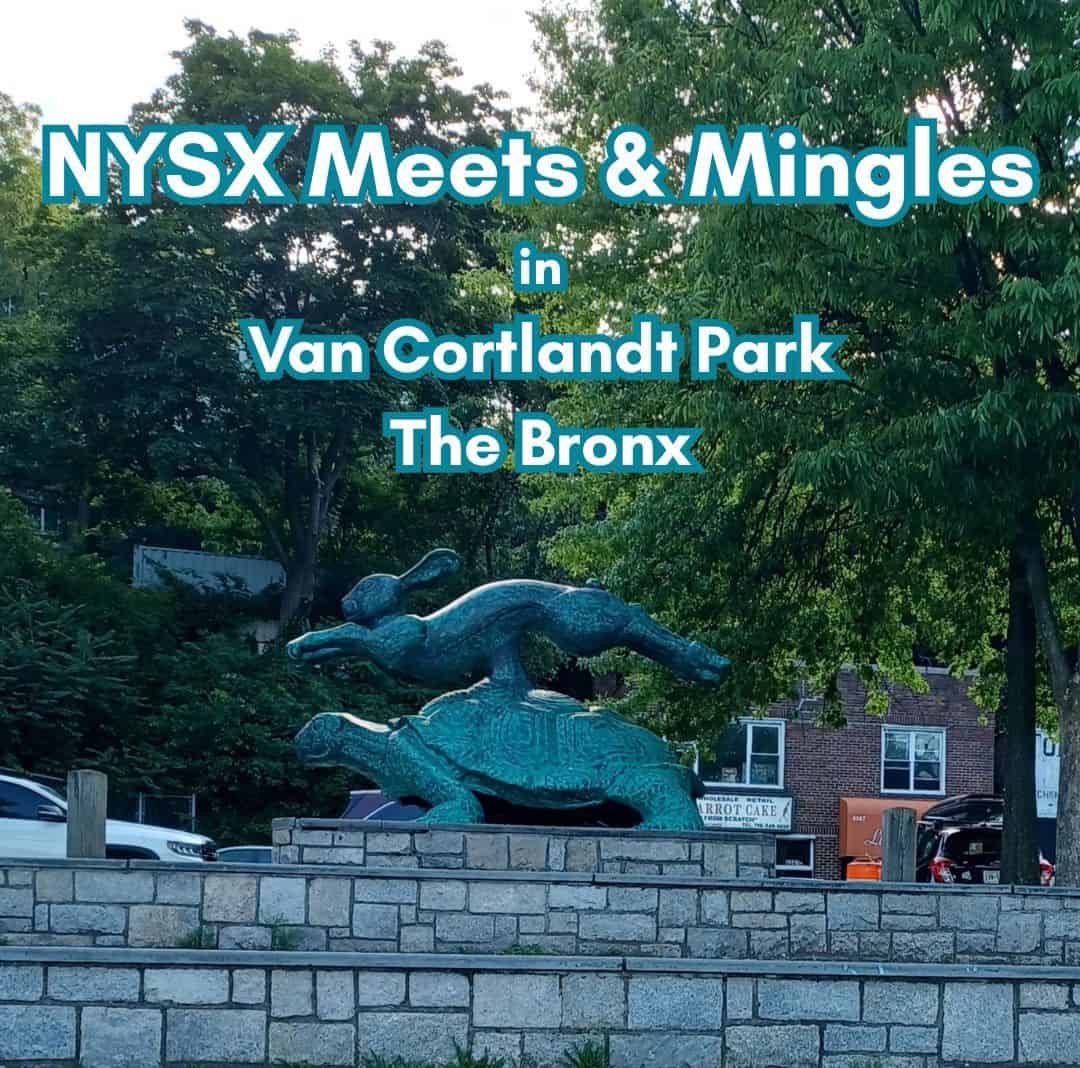
Introducing: NYSX Meets & Mingles

Our 2026 calendar will include a series of four casual gatherings, bringing together new friends and old in a space where new connections can bloom and community bonds can get stronger. Some might be creative in vibe (like an open mic or poetry reading), some might be more focused on networking and building support systems, and some will be pure silly fun!


Verses vs. Verses

Saturday, April 25, 2026

3:30-5:30pm

Everything Goes Book Cafe & Neighborhood Stage

208 Bay Street, Staten Island

Our next Meets & Mingles event will be an open-mic salon, inviting local poets and Shakespeare fans alike to come help us celebrate National Poetry Month, which also happens to be the Bard's birthday month. We hope to gather a roster of performers that includes both:

For more info - including how to register if you'd like to perform - check out our RSVP page.


Meet the Playwrights: Teresa Miller

LOGO - New York Shakespeare Exchange + The Cry Havoc Company present Brave New Work

In partnership with our friends at The CRY HAVOC Company, we are thrilled to announce that we've chosen our cohort of four playwrights for the inaugural cycle of our development series, Brave New Work. The series invites playwrights to create original works that will draw inspiration from Shakespeare's canon, but evolve into something wholly their own.


Meet the Playwrights
TERESA MILLER

Teresa Miller is a Philadelphia-based playwright and multidisciplinary theatre artist whose work bridges history, community, and imagination. She writes character-driven plays exploring memory, race, labor, and legacy, including Ephraim Slaughter: Freedom’s Witness and Last Night in Jerusalem. Her plays have been developed with theatre companies and museums, and she was selected as one of four writers for the Cry Havoc Company’s Brave New Work: Shakespeare as Prologue inaugural cohort in collaboration with the New York Shakespeare Exchange, an experience she is deeply honored and excited to be part of. Across her work, she centers storytelling as a tool for connection, dignity, and cultural preservation.

Which of Shakespeare's plays have you chosen as the springboard for your play? What intrigues or excites you about building on that foundation? 

What has always intrigued me about Hamlet is that it ends with almost everyone dead, but the emotional and political consequences of those deaths are largely left unexplored. We leave the play with Horatio as the sole surviving witness, charged with telling the story. That moment felt like an opening rather than a closing. My play After Denmark begins in that silence. I’m interested in what happens when the spectacle of tragedy has ended and only the witnesses remain. What does it mean to carry the memory of a kingdom that has collapsed? How does someone explain those events to people who were never there?

Which NYC neighborhoods make you feel the most at home? 

Although I am not a New Yorker, I’ve always felt at home in Harlem. There's something about Harlem that feels deeply theatrical. From the layering of history, music, street life, and memory. It’s a place where past and present feel like they’re standing beside each other on the same block. As a playwright who is interested in memory, lineage, and the way stories live inside communities, Harlem has always felt like a neighborhood where storytelling is embedded in the architecture The streets carry the echoes of writers, musicians, organizers, and ordinary people whose lives were anything but ordinary.

What types of prompts or source material are you most drawn to as a playwright?  How would you describe your artistic voice or point-of-view? 

I’m drawn to history, memory, and the spaces where personal lives intersect with larger historical forcesMany of my plays begin with a question about what has been forgotten or overlooked. I’m interested in the people who stand at the edges of historical narratives and those are the witnesses, the survivors, the ones tasked with carrying the story forward. Sometimes the starting point is archival research. Sometimes it’s a fragment of history that refuses to let go. Sometimes it’s a literary text that contains a silence I want to explore. I’m particularly interested in the tension between documented history and lived experience and how theater can hold both at the same time. My artistic point of view often sits at the intersection of history, memory, and the surreal. I ’m interested in plays that move between the visible world, the invisible one and between what can be documented and what can only be felt. Many of my plays include elements of magical realism or heightened theatricality because memory itself rarely moves in a straight line. I’m also deeply interested in witnessing. And that is who bears witness to events? Who gets to narrate them and what responsibility comes with that act. Whether I’m writing about a historical figure, a community, or a fictional character, my goal is to create work that invites audiences to step into a moment where past and present are in conversation with each other.


Meet the Playwrights: Mollie Gordon

LOGO - New York Shakespeare Exchange + The Cry Havoc Company present Brave New Work

In partnership with our friends at The CRY HAVOC Company, we are thrilled to announce that we've chosen our cohort of four playwrights for the inaugural cycle of our development series, Brave New Work. The series invites playwrights to create original works that will draw inspiration from Shakespeare's canon, but evolve into something wholly their own.


Meet the Playwrights
MOLLIE GORDON

Mollie Gordon (she/her) is a queer playwright and theatre-maker based in Newark, New Jersey. She is currently a member of the 2025-26 QueerSpeech Cohort with The Cult Collective. Her play If It Weren't for the Women, We'd Still Be Stuck in the Desert was a 2024 O'Neill National Playwrights Conference semifinalist, the 2024 winner of the Scribe Playwriting Competition, finalist for the 2026 MOXIE Lamoise New Works Festival, and long listed for the 2026 Distillery New Works Festival. Mollie's plays have been developed with The Bechdel Group, Athena Project, Personal Pizza Party, and Sarah Lawrence College.


Which of Shakespeare's plays have you chosen as the springboard for your play? What intrigues or excites you about building on that foundation? 

I've chosen Measure for Measure as the springboard for my play. It's a play that feels very timely with its themes of political hypocrisy and whose voice society chooses to believe. Isabella is an incredibly captivating and memorable central character, yet she only has half as many lines as the Duke. Her fate is left really ambiguous at the end of Shakespeare's play, so I was interested to imagine a more hopeful future for her. 

Which NYC neighborhoods make you feel the most at home? 

I always feel really at home in the West Village - it's a great area to just walk around and I love the restaurants. I grew up in Cobble Hill, so I also love to visit my favorite places there, particularly the Brooklyn Farmacy & Soda Fountain!

What types of prompts or source material are you most drawn to as a playwright?  How would you describe your artistic voice or point-of-view? 

I'm drawn to prompts/source material that feel unresolved or open-ended. I think this is because my artistic voice can be very playful, and I like to use devices like magical realism to explore the unexplored. This is why I find comedy an indispensable tool as well, because an audience that laughs together is more likely to want to talk to each other. I love when theater can open a conversation rather than close it, so a piece as richly complicated as Measure for Measure feels like an exciting jumping-off point.