Freestyle Labs return in August!

  • Post published:

Freestyle Labs return in August!

Find us making the rounds of all five boroughs in August, October, and November

Last presented at the 53rd Street NYPL branch (2018-20) and virtually (2021-22), Freestyle Labs are community conversations hosted by NYSX on a variety of topics. Each lab begins with a brief performance of excerpts from Shakespeare that highlight the topics to be discussed, then the performers are joined by additional non-performer experts for a moderated discussion on those topics. Finally, we will open up the discussion for questions or observations from the audience.


This year, we are planning to tour all five boroughs with Labs on the following theme:

Ages & Stages

How Shakespeare helps us think about youth, experience, inter-generational relationships, and the many ways we "come of age" in a lifetime

---

Next up:

August 29th
2:30-4pm
Brooklyn Heights Library Branch
Brooklyn, NY

***

Dates, times, and locations for the labs in Manhattan, Queens, and The Bronx are TBA - stay tuned!

***

Past dates in this series:

August 1st
Everything Goes Book Café
Staten Island, NY

---

For upcoming labs, we are currently seeking:

  • Actors to perform in the first section of the Lab and join the panel discussion for the rest of the event. We are seeking actors in the following age ranges:
    • Actors under 30 - to play roles such as Juliet, Romeo, Regan, Prince Hal
    • Actors over 40 - to play roles such as Capulet, Lady Capulet, Cleopatra, Marc Antony, Beatrice, Benedick
    • Actors over 50 - to play roles such as Lear and King Henry IV 
  • Non-actor panelists to join the discussion and offer points of view based in personal expertise and experience. We are especially interested in panelists who may represent the following fields/professions:
    • Education
    • Health Care (physical and/or mental)
    • Social Services
    • Politics and/or Community Organizing
    • Physical Therapy/Personal Training
    • Doulas (birth, post-partum, or end-of-life)
    • HR Professionals

If you are interested in participating as either an actor or a non-actor panelist: please email us with a brief message about yourself and the perspective you bring to this conversation!

Even if you're not a fit for either of those roles, you're surely a fit for the most important role - AUDIENCE! These community discussions need a robust community to be a success, so we do hope you'll plan to join us for one of more of the five labs in the series.


Meet our ShakesBEER team!

  • Post published:

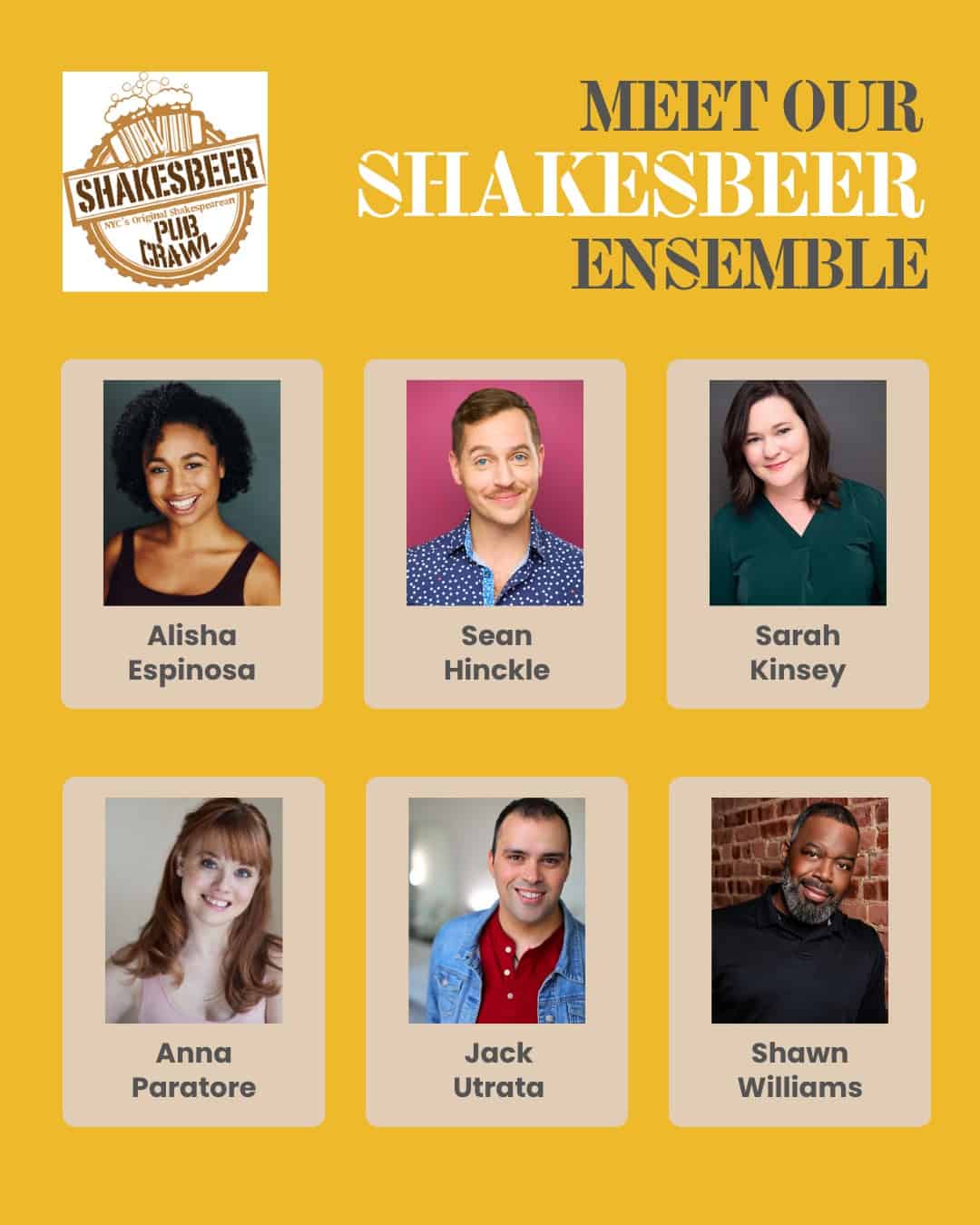
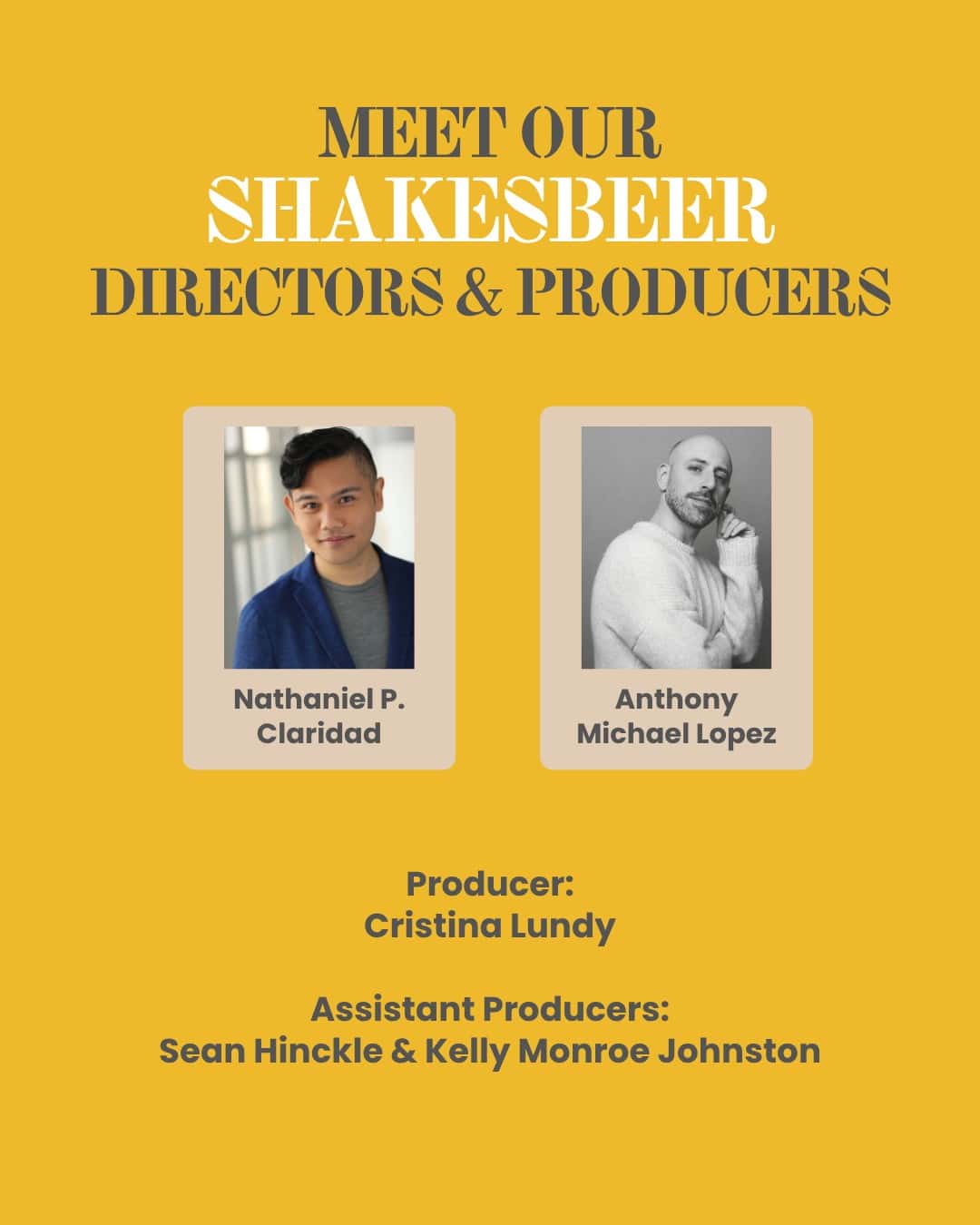
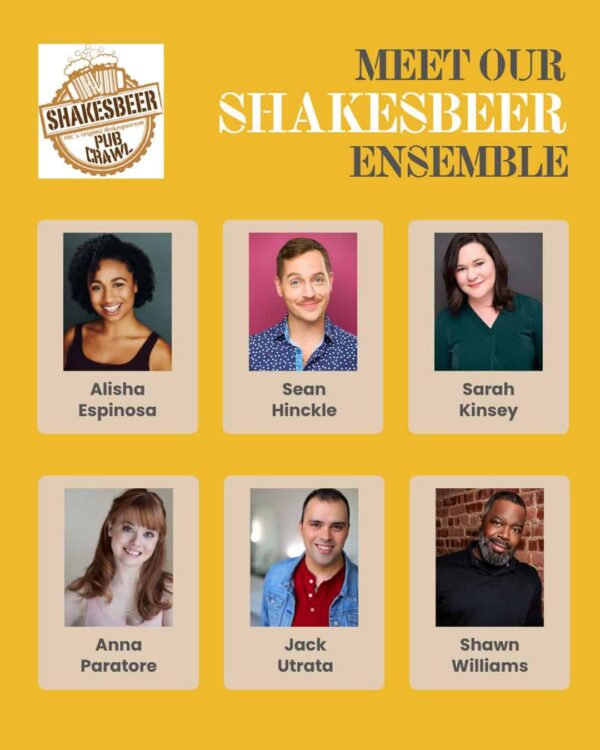
Meet our ShakesBEEReans!

This round of crawls in Sunnyside brings us a stellar mix of veterans and newbies, united by twin passions for both Shakespeare and utter tomfoolery.

Drink tickets included, you say? What can I get for them?

Beer selections at all bars

Margaritas at Sanger Hall & Mad For Chicken

Whiskey Mules and Rusty Nails at Maggie Mae's

Pinot Noir & Pino Grigio at The Lowery

Red & White Sangrias at The Lowery & Mad For Chicken

Spiked Mad Punch at Mad For Chicken

N/A Hazy IPA at Sanger Hall & Heineken 0.0 at Maggie Mae's

Mocktails at The Lowery & Virgin Mad Punch at Mad For Chicken


Will we see you there?

May 30 & June 6, 2026

3-6pm

Check-in begins at 2:30pm

To buy tickets and learn more, click here.


Tickets for our next ShakesBEER are now on sale!

  • Post published:

Tickets On Sale Now!

Join us as we take ShakesBEER across the East River to a new 'hood - Sunnyside, Queens!  We'll start out the crawl on the gorgeous, tree-lined sidewalks of Skillman Ave in Sunnyside Gardens, then work our way east (look for the Manhattan skyline in the distance to keep your sense of direction!).  We'll end the crawl on Queens Boulevard, just a couple of blocks from the 7 train - your chariot home after you've huzzah-ed yourself hoarse and filled up on delicious food and drinks.


ShakesBEER comes to Sunnyside

Saturdays May 30 & June 6, 2026

3-6pm

Check-in begins at 2:30pm

Sanger Hall - 48-20 Skillman Avenue

Including scenes from Taming of the Shrew, Midsummer Night's Dream, and more!

To buy tickets or learn more, click here.


Meet our Collaborators: The CRY HAVOC Company

  • Post published:

LOGO - New York Shakespeare Exchange + The Cry Havoc Company present Brave New Work

As we draw close to the end of this inaugural cycle of Brave New Work, we wanted to cast our final spotlight on our partners in bringing this exciting new initiative to life!


Meet our Collaborators
The CRY HAVOC Company

The CRY HAVOC Company believes that writing a script doesn’t have to be a solitary experience, and that feedback at key points in the writing process can bring you closer to your goals. Their approach to script development places the writer’s goals at the center of the workshop discussion, ensuring that collaborators are offering feedback in service of the writer’s vision – the play they are trying to write.

Read on to learn more about the company’s approach to developing new work, what excites them about this collaboration with NYSX, and more – featured company members are Jen Curfman (Co-Artistic Director), Jerzy Gwiazdowski (Managing Director), and Katelin Wilcox (Associate Artistic Director).

===

What are your favorite elements of CRY HAVOC's approach to new play development? What elements do playwrights seem to find most effective or enriching?

Jen:  In the CRY HAVOC approach, playwrights are empowered to articulate their goals for their script during the moderated discussion, which allows focused, specific feedback from the artists at the table. It’s thrilling to be in the room with a community of artists who are there in service of each other’s work. Playwrights often tell us that the collaborative space helps them challenge their own writing process and deepen their work. 

Jerzy:  I love meeting and working with writers. Selfishly, that's my favorite part. Writing can be so lonely; our development process meets a writer where they are and brings their work into a room full of artists ready to support their goals.

Katelin:  I think our guiding principle of "helping the playwright write the play they are trying to write" and the facilitator component are things that I, and our playwrights, really respond to. Sometimes feedback processes can be muddied by personal taste and opinions. We've worked really hard to create a structured approach that keeps feedback focused and, with the role of the facilitator, helps the playwright be prepared to receive and synthesize that feedback. 

What excites you most about the Brave New Work collaboration with NYSX?  

Katelin:  I love Shakespeare and I have been absolutely blown away by the way our playwrights have taken his work as a jumping-off point and come up with such varied, creative, thought-provoking work.  There are lots of little reference points that will delight Shakespeare nerds like me, but the plays also stand completely on their own.  I also feel that as artists we are in desperate need of artistic community right now, and this collaboration has allowed both companies to expand our respective communities of artists in a beautiful, exciting way.  

Jen:  As artists, we have the opportunity to interrogate the works of Shakespeare just as much as we celebrate these plays. What could be more exciting than bringing today’s writers together to challenge and dance with Shakespeare in their own voices? Brave New Work indeed!

Jerzy:  The project doesn't take Shakespeare for granted. Each writer in the cohort (and everyone that applied to the program) brought their unique experience of Shakespeare's work to the table. These plays mean so much to so many and Brave New Work demonstrates that meaning through the perspectives of these four brilliant contemporary artists.

If you could set a new adaptation of any Shakespeare play within a particular neighborhood, area, or demographic/cultural group in 2026 NYC, what would your pitch be?

Jerzy: Let's put Timon of Athens in modern Manhattan. New York has the highest concentration of extreme wealth in the United States - the country with the highest income inequality among the world's so-called "developed" nations. In New York City, the racial wealth gap is even more grotesque. The city's density forces us to confront, or at least witness, these contradictions daily. Seems like an apt setting for a play about wealth, poverty, false generosity, loyalty and the structures that sustain inequality.

Katelin: I've lived in Sunset Park, Brooklyn for over a decade, and our namesake park is such an oasis of calm and fun within the hustle and bustle of our busy neighborhood.  I'm a sucker for site-specific theater, so I think it would be fun to set one of the plays that contrast "court and country life" (As You Like It, Midsummer, Winter's Tale, Cymbeline) partly in our busy commercial district and partly in Sunset Park itself, taking the audience along for the ride!

Jen:  Whether it’s examining modern politics through Mark Antony, exploring the fluidity of gender with Viola, or grieving a lost homeland with Thomas Mowbray, there’s something in Shakespeare that speaks to our joys, our rage, our city, our moment. The possibilities are endless!

 

Meet the Playwrights: Marcus Scott

  • Post published:

LOGO - New York Shakespeare Exchange + The Cry Havoc Company present Brave New Work

In partnership with our friends at The CRY HAVOC Company, we are thrilled to announce that we've chosen our cohort of four playwrights for the inaugural cycle of our development series, Brave New Work. The series invites playwrights to create original works that will draw inspiration from Shakespeare's canon, but evolve into something wholly their own.


Meet the Playwrights
MARCUS SCOTT

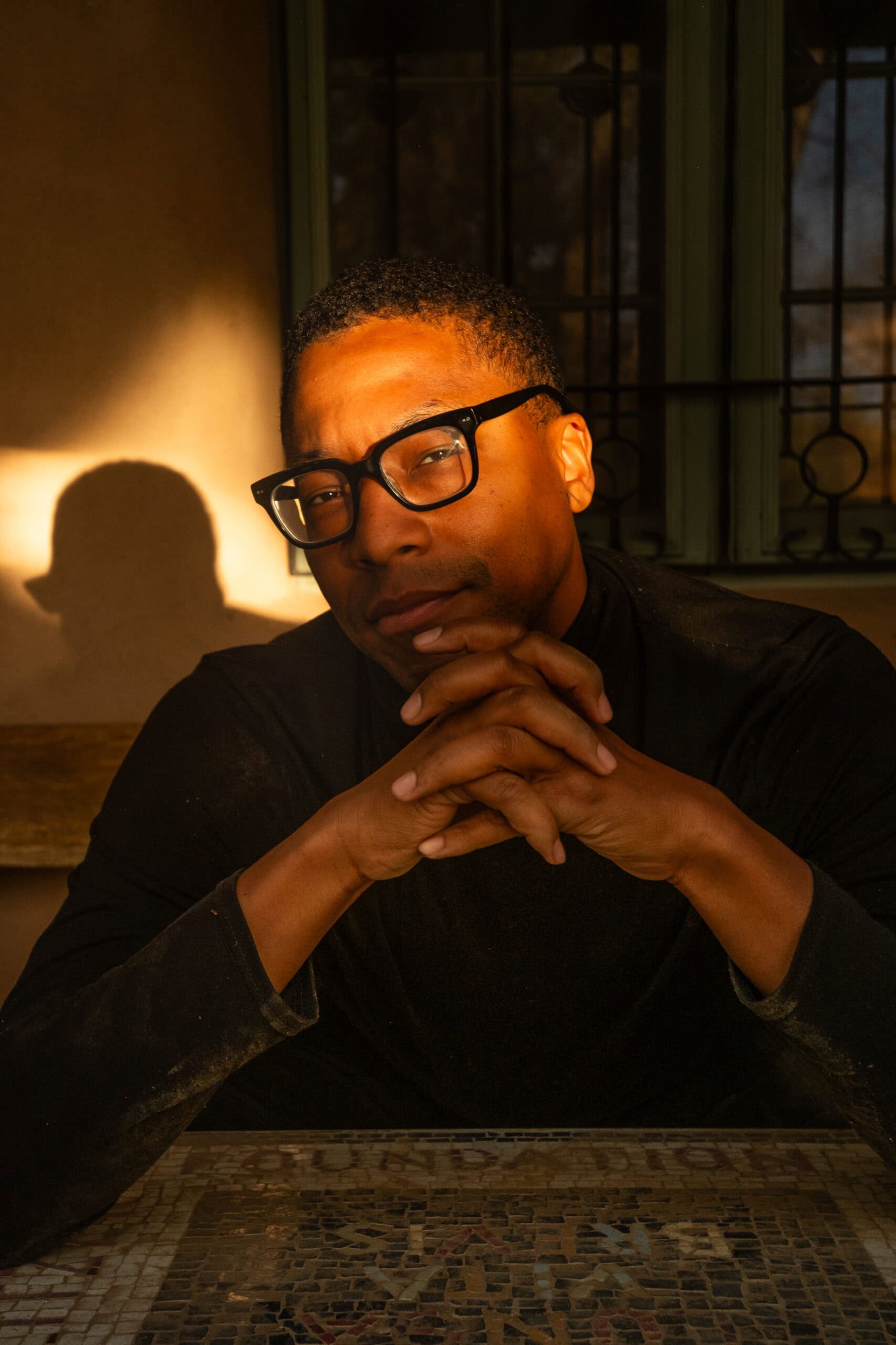
Marcus Scott is a dramatist and journalist. Notable plays include Tumbleweed (2025 Orlando Shakes PlayFest), Sibling Rivalries, and There Goes the Neighborhood, which have collectively earned finalist recognition from the O’Neill NPC, Princess Grace Awards, Blue Ink Award, SDNPF and BAPF. Musical credits include Cherry Bomb and a commissioned adaptation of Beethoven’s Fidelio for Heartbeat Opera (The Met Museum; NY Times Critic’s Pick). Recent honors include the Robert Chelsey/Victor Bumbalo Award, a Helene Wurlitzer Foundation Residency, and finalist status for the 2025 Ryan Hudak LGBTQ+ Award, the Dramatists Guild Foundation National Fellowship, and the Many Voices Fellowship. MFA: NYU Tisch. 

Which of Shakespeare's plays have you chosen as the springboard for your play? What intrigues or excites you about building on that foundation? 

I’ve chosen The Tempest as the springboard for my play. I’m fascinated by its perturbing resolution; the way it performs forgiveness while leaving huge ethical tensions simmering under the surface. Prospero renounces his magic, but the systems of control he built over the island, over Ariel, and over Caliban are never truly interrogated. That lingering silence is what gets me. Prospero is a paranormal propagandist — a father and a playwright orchestrating reality. I wanted to explore the aftershock of that magic. What happens when the architect of the narrative disappears? When the script is gone, whose memory prevails? This play enters the space after the “happy ending” to see if liberation is possible when the language of power still hangs in the air.

Which NYC neighborhoods make you feel the most at home? 

Harlem and Bed-Stuy are where I feel most at home. There’s an intellectual and sociological electricity in Harlem that feels ancestral and forward-thinking; you can practically feel the lineage of artists, culturati, organizers, preachers, dreamers in the pavement. It’s a continuum of Black brilliance where possibility feels infinite. Bed-Stuy was my first home during grad school, and it’s communal in a way you don't find elsewhere. It’s the rhythm of stoop conversations, music spilling from open windows, and "aunties" who will read you for filth before inviting you in for a homecooked meal. Both neighborhoods are meccas where ambition and authenticity coexist — places where Black nerds, artists, and strivers can just be without needing a translator.

What types of prompts or source material are you most drawn to as a playwright?  How would you describe your artistic voice or point-of-view? 

I’m drawn to material that interrogates power: who wields it, who enforces it, and who dares to resist it. In an era of endless reboots, I’m less interested in the repetition and more interested in the afterlife. I want to see the psychological debris left at the margins of the “canon” once the curtain falls. My work is an excavation of Black interiority. I’m fascinated by the contradictions — Silicon Valley futurists, Divine Nine social climbers, and Afropunk rockers. My voice is analytical but lyrical; 

I want to deconstruct narratives shaped by capitalism and anti-Blackness to help characters reclaim what’s been stolen, whether that’s memory or self-definition. Ultimately, I believe imagination is the most radical tool we have for reclamation.